Structured observational lanes

Datasets

A structured view of Astrolyte's current observational lanes, from raw source records to processed and curated outputs.

Inventory

Current observational blocks

Each project card shows the lane shape, then anchors it with one mirrored figure artifact and a local notes surface so the proof remains browsable even when upstream GitHub previews are unreliable.

rawprocessedcuratedparquetFITSvalidated

iris-solar-uv-data

IRIS solar UV observations

Image-first IRIS Level 2 workflows with metadata indexing, quicklook generation, ROI comparison, and event-candidate export.

Checkpoint 2026-03-25
rawFITSprocessedvalidated

IRIS defines the ingest and indexing backbone: raw Level 2 references stay untouched while per-OBS quicklooks, ROI time series, and event catalogs are produced downstream.

07

Real observations

Seven real IRIS windows are exercised in the current checkpoint.

09

Merged event rows

The merged event table combines seven per-OBS catalogs.

02

Audit cases

Duplicate-window families are explicitly tracked instead of overwritten.
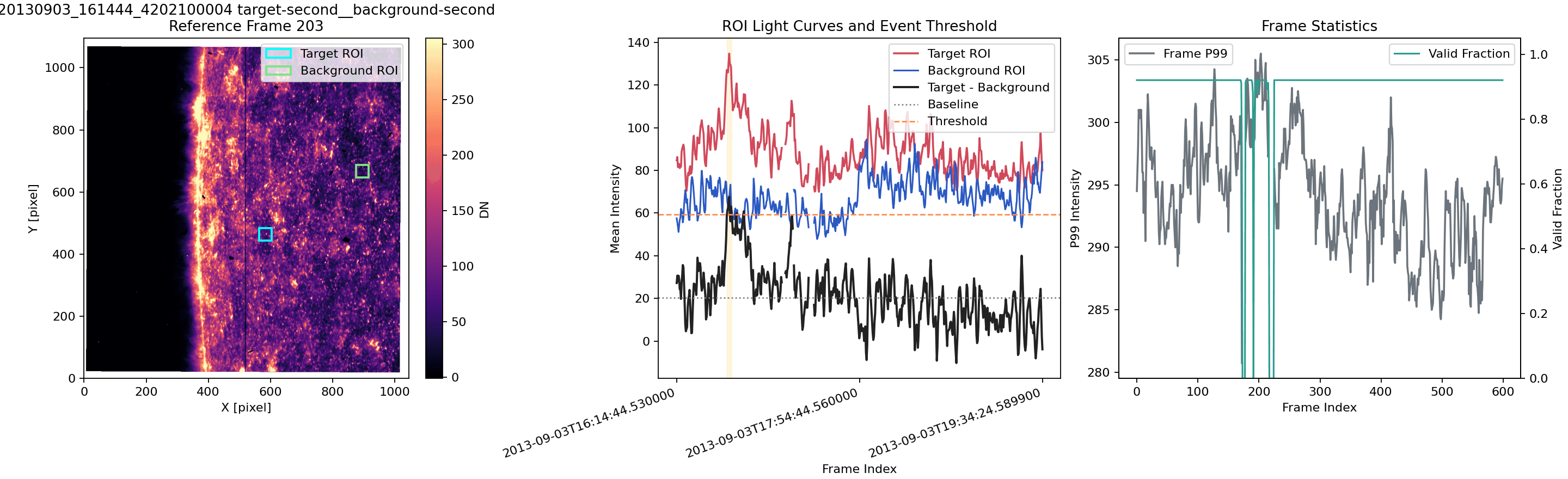
IRIS pair-audit figure with a reference frame, ROI markers, ROI light curves, a threshold line, and frame statistics.

Technical proof

Open proof figure

Why this artifact

Duplicate-window pair audit artifact

This audit export keeps the reference frame, ROI placement, target-minus-background trace, baseline, threshold, and frame-quality drift visible in one panel for the later 161444 window.

Selected figure path

reports/figures/pair_audits/20130903_161444_4202100004__20130903_202024_4202100004/target-second__background-second__20130903_161444_4202100004.png

  • Selected because it exposes image-space inspection and time-series validation in the same artifact.
  • The pair-audit view makes duplicate-window handling inspectable instead of hiding it behind a summary table.

Outputs

  • metadata index
  • SJI quicklook outputs
  • ROI time series
  • event candidate catalogs
  • merged event table
  • pair audit outputs

Workflow

  • remote archive query
  • selected observation download
  • metadata indexing
  • quicklook generation
  • ROI comparison
  • event export and pair audit

Validation notes

  • Raw, metadata, derived, and report outputs remain separated instead of collapsing into one folder.
  • obs_dir-aware handling keeps repeated obsid windows from overwriting one another.
  • Pair audits are used to separate auto-ROI drift from actual scene change.
rubin-sampling

ZTF-linked time-series records

Public survey light curves aligned with Gaia DR3 truth sets, standardized into project schema, and evaluated for period recovery.

Baseline snapshot 2026-03-09
rawparquetprocessedvalidated

Rubin Sampling defines the transformation layer: truth sets, live ingest, schema standardization, parquet artifacts, and baseline evaluation all stay visible as separate products.

30

Usable baseline objects

Thirty RR Lyrae objects survive coverage and ingest filtering.

24/30

Period recovery

Current baseline recovery holds at twenty-four of thirty objects.

14,011

Photometry rows

The standardized baseline parquet exposes analysis-friendly tabular output.

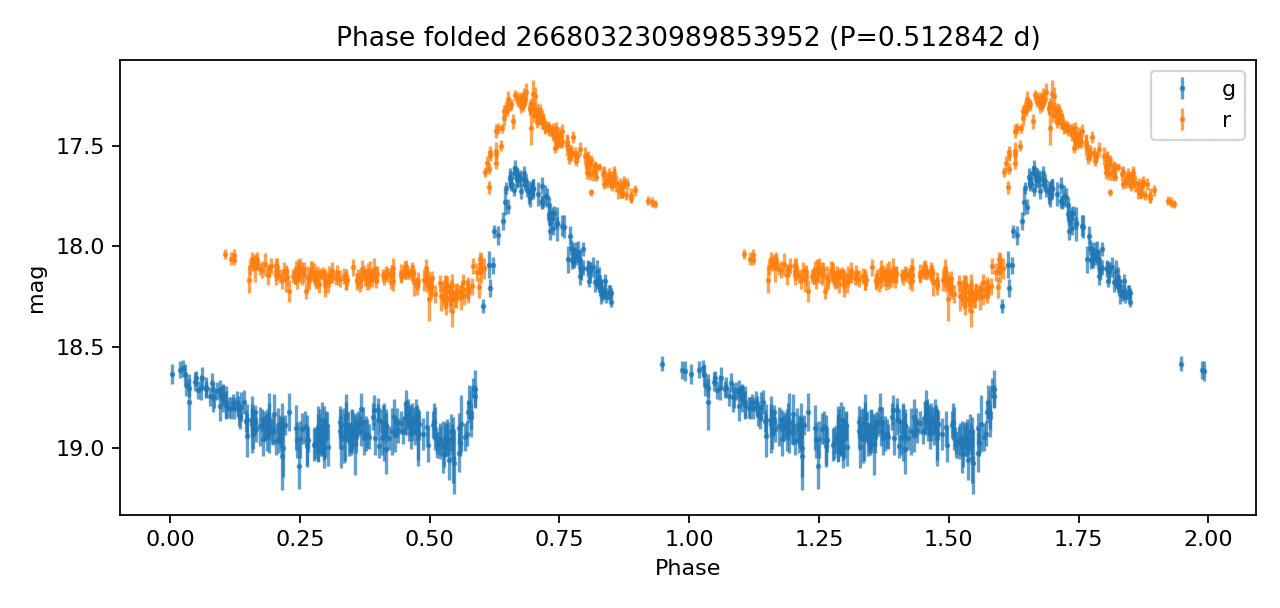
Rubin Sampling phase-folded RR Lyrae figure with g and r photometry at a recovered period.

Technical proof

Open proof figure

Why this artifact

Phase-folded recovery sample

A recovered RR Lyrae example from the baseline bundle, showing standardized g/r photometry folded at the detected period after live ingest and schema normalization.

Selected figure path

results/rrlyrae_baseline/figures/phase_folded_266803230989853952.png

  • Selected because it proves the pipeline reaches an interpretable folded solution, not just a result row in parquet.
  • This artifact sits behind the published 24/30 recovery snapshot and makes the recovered periodic structure visible.

Outputs

  • Gaia truth tables
  • raw light-curve parquet
  • standardized baseline batch
  • ingest summary
  • period results
  • evaluation tables
  • figure bundles

Workflow

  • Gaia truth download
  • live ZTF ingest
  • schema standardization
  • coverage filtering
  • period search
  • baseline evaluation

Validation notes

  • Failure modes such as P/2 and 2P aliasing are surfaced as part of evaluation, not hidden away.
  • The lane keeps truth, ingest, standardized, and evaluation artifacts separate but connected.
  • Baseline metrics are grounded in a real 30-object snapshot rather than placeholder sample data.

t-crb-project

T CrB observational assets

Clean photometry products, overlap validation, and a raw-image lane spanning modern and historical archive context.

Lane hardening 2026-03-08
rawprocessedcuratedvalidated

T CrB defines the reproducibility and validation layer: clean products, figures, overlap metrics, and raw-image manifests coexist inside one explicit workflow.

174,872

Modern V points

The 2015-2025 modern V lane remains the clean operational baseline.

71

Overlap bins

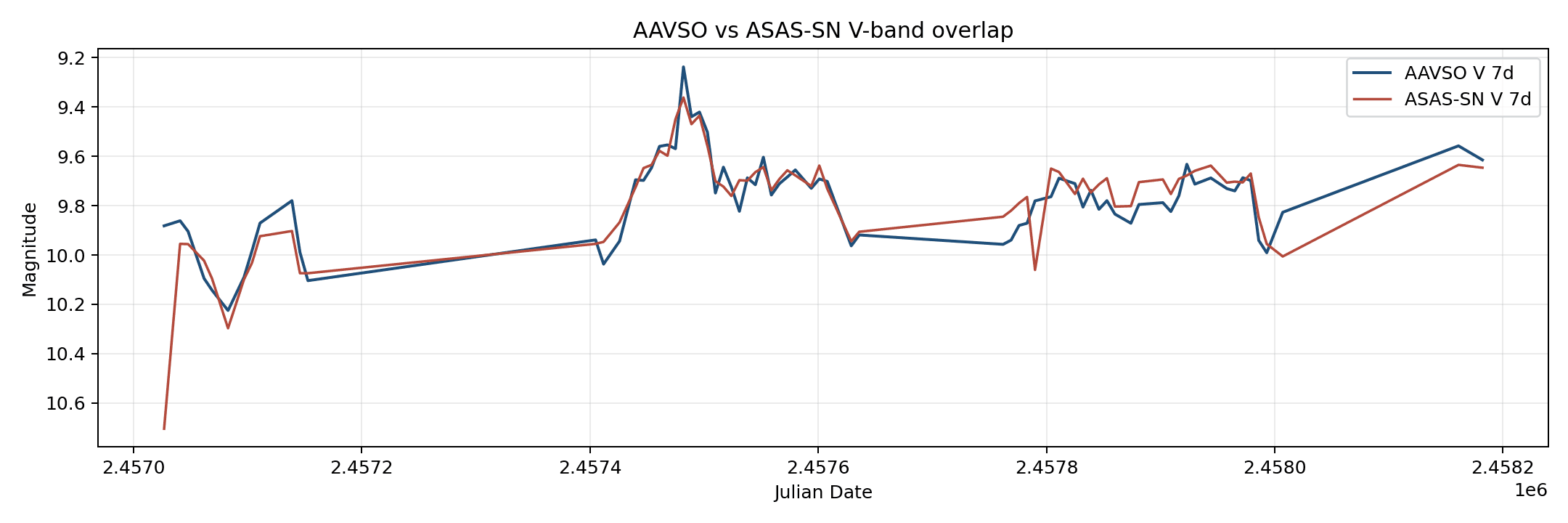
AAVSO vs ASAS-SN overlap checks are exported on a shared seven-day grid.

749,410

Core rows

The broader cleaned observational baseline remains available behind the lane.

T CrB validation figure comparing AAVSO and ASAS-SN V-band observations on a shared seven-day grid.

Technical proof

Open proof figure

Why this artifact

Cross-source overlap validation

A seven-day V-band overlay aligning AAVSO and ASAS-SN series on the same time axis so agreement and divergence remain visible at the plot level.

Selected figure path

figures/overlay_aavso_vs_asassn_V_overlap.png

  • Selected because it shows cross-provider validation directly instead of only presenting a cleaned single-source curve.
  • The figure stays tied to exported overlap bins, so the visual check and tabular metrics come from the same workflow.

Outputs

  • modern V clean products
  • all-cycles Vis products
  • overlap validation figures
  • raw-image timeline assets
  • DASCH / PS1 / Legacy support assets
  • notes and manifests

Workflow

  • clean product generation
  • window exports
  • overlap validation
  • metrics export
  • raw-image manifesting
  • archive support staging

Validation notes

  • Overlap validation keeps tables, figures, and exported metrics tied to the same workflow lineage.
  • Raw-image support is treated as a first-class lane rather than an afterthought appended later.
  • The lane demonstrates how historical context can live beside modern photometry without losing reproducibility.