Why this artifact
Cross-source overlap validation
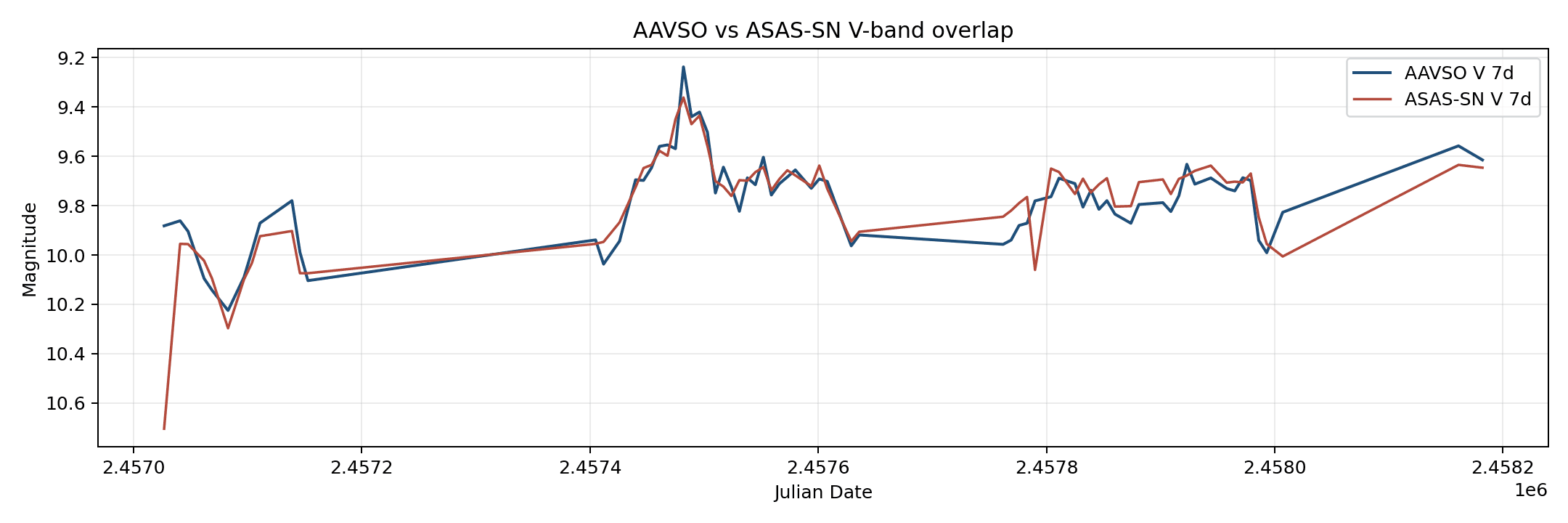
A seven-day V-band overlay aligning AAVSO and ASAS-SN series on the same time axis so agreement and divergence remain visible at the plot level.
rawprocessedcuratedvalidated
t-crb-project
Lane hardening 2026-03-08
Clean photometry products, overlap validation, and a raw-image lane spanning modern and historical archive context.
Lane notes
T CrB defines the reproducibility and validation layer: clean products, figures, overlap metrics, and raw-image manifests coexist inside one explicit workflow.
Mirrored proof artifact
Open proof figureThis figure is served from Astrolyte's own public assets so the dataset proof stays accessible even when GitHub file preview or raw delivery is unstable.
Why this artifact
A seven-day V-band overlay aligning AAVSO and ASAS-SN series on the same time axis so agreement and divergence remain visible at the plot level.
Reference figure path
figures/overlay_aavso_vs_asassn_V_overlap.png
Validation readout
Operational notes
These notes are served directly from Astrolyte so each lane keeps a stable, browsable checkpoint page independent of upstream GitHub rendering glitches.
Outputs
Workflow
Validation notes